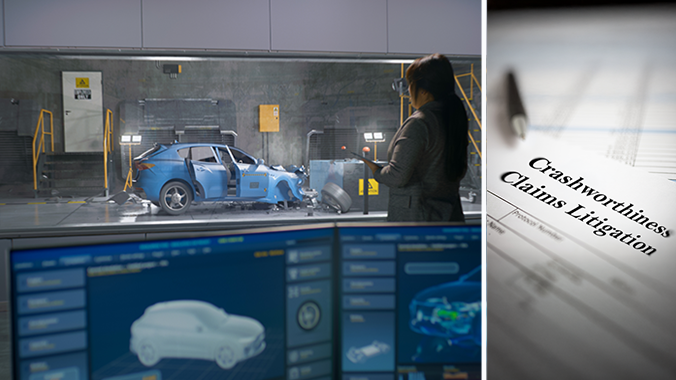
Evaluating and Litigating Vehicle Crashworthiness Claims: Determining Viability and Building a Successful Case

E. Todd Tracy is a Board-Certified Texas attorney who has spent more than 38 years litigating vehicle crashworthiness cases and holding the automotive industry accountable for safety failures. Throughout his career, he has tried 179 crashworthiness cases against major domestic and international manufacturers and suppliers, including GM, Ford, Chrysler, Toyota, Nissan, Honda, Hyundai, Ferrari, Mercedes-Benz, Paccar, Kenworth, TRW, Key Safety, Takata, Tokai Rika, Dorel Juvenile Group, and Graco.
2 hour CLE
Tuition: $195.00
Get this course, plus over 1,000+ of live webinars.
Learn More
Training 5 or more people?
Sign-up for a law firm subscription plan and each attorney in the firm receives free access to all CLE Programs
Program Summary
What Will You Learn
Attendees will learn how to identify and evaluate viable crashworthiness claims within catastrophic injury and wrongful death cases. They will understand how forensic, medical, and engineering evidence work together to prove enhanced injury. The program will teach how to establish feasible safer alternative designs and anticipate manufacturer defenses. Participants will also learn how to screen cases effectively and recognize the most common crashworthiness claim patterns.
What Will You Gain
Attendees will gain a strategic framework for uncovering additional recovery when traditional insurance is insufficient. They will build confidence in analyzing complex technical evidence and coordinating the right experts. The program provides practical tools for early case assessment and disciplined resource allocation. Ultimately, participants will strengthen their ability to increase case value and improve outcomes in high-stakes litigation.
Key topics to be discussed:
- Crashworthiness principles
Understand the five foundational safety principles that govern occupant protection and form the backbone of enhanced-injury litigation. - Enhanced injury causation
Learn how to distinguish injuries caused by the initial collision from those caused by defective vehicle design or safety system failure. - Multidisciplinary case evaluation
Integrate forensic reconstruction, biomechanical analysis, medical evidence, and engineering data to assess claim viability early and accurately. - Safer alternative design proof
Develop strategies to prove technologically and economically feasible alternative designs that would have reduced or prevented the injury. - Strategic case screening
Identify when to pursue a crashworthiness claim—and when to decline—based on liability strength, damages potential, and litigation investment. - Expert & litigation strategy
Build and coordinate the right team of technical experts to withstand admissibility challenges and maximize settlement and verdict outcomes.
Date / Time: March 13, 2026
- 1:00 pm – 3:10 pm Eastern
- 12:00 pm – 2:10 pm Central
- 11:00 am – 1:10 pm Mountain
- 10:00 am – 12:10 pm Pacific
 Closed-captioning available
Speakers
Todd Tracy | The Tracy Law Firm
E. Todd Tracy is a Board-Certified Texas attorney who has spent more than 38 years litigating vehicle crashworthiness cases and holding the automotive industry accountable for safety failures. Throughout his career, he has tried 179 crashworthiness cases against major domestic and international manufacturers and suppliers, including GM, Ford, Chrysler, Toyota, Nissan, Honda, Hyundai, Ferrari, Mercedes-Benz, Paccar, Kenworth, TRW, Key Safety, Takata, Tokai Rika, Dorel Juvenile Group, and Graco. With a degree in applied physics, Mr. Tracy combines technical knowledge with courtroom experience, handling cases in 42 states against every major vehicle manufacturer except Volvo. Over the past two decades, his firm has conducted 650 crash and sled tests to prove defect and safer alternative design—often performing testing when NHTSA and manufacturers did not—and he makes those tests publicly available to lawyers, regulators, and the industry. He has testified before House and Senate Committees on vehicle safety improvements and has remained active in the Texas Trial Lawyers Association for more than 30 years, teaching, writing, and speaking nationwide on product liability and vehicle safety issues.
- Education & Credentials
Mr. Tracy holds a degree in applied physics, a foundation that informs his technical approach to vehicle defect litigation. He is Board Certified in Texas, reflecting his specialized experience and qualifications in his field of practice.
- Recognition & Leadership
Mr. Tracy has testified before various U.S. House and Senate Committees on vehicle safety issues, including needed improvements to better protect occupants. He has been active in the Texas Trial Lawyers Association for over 30 years, taught for 20 years at TTLA’s Trial Advocacy College of Texas, spoken at TTLA and 35 other state trial lawyer organizations, and authored 178 articles to date.
- Professional Involvement
Over the past 20 years, Mr. Tracy’s firm has conducted 650 crash and sled tests to prove defect and safer alternative design, including testing performed when NHTSA and manufacturers did not conduct such testing. He makes these tests available to other lawyers, NHTSA, and the vehicle industry, and has also taught product liability, cross-examination techniques, and design defect case development at numerous law schools nationwide.
- Experience
For more than 38 years, Mr. Tracy has focused on vehicle crashworthiness litigation, trying 179 cases against major domestic and international manufacturers and suppliers. He has handled cases in 42 states and has litigated against every major vehicle manufacturer except Volvo, consistently working to hold the industry accountable for safety failures.
Agenda
I. Forensic, physical, medical, and engineering considerations in evaluating and proving a vehicle crashworthiness case | 1:00pm – 1:30pm
Evaluating a crashworthiness case requires integrating accident reconstruction, vehicle dynamics, biomechanical analysis, and detailed medical causation evidence. Attorneys must determine whether injuries were caused by the initial collision or by a failure of the vehicle’s safety systems. This involves analyzing crush patterns, intrusion into the occupant survival space, restraint performance, airbag timing, and post-impact conditions. Understanding how physical evidence aligns with medical findings is essential to proving enhanced injury. Without this multidisciplinary foundation, a crashworthiness claim cannot stand.
II. Proving safer alternative designs that are technologically and economically feasible, that would not adversely affect the utility of the vehicle and would have prevented the injury or death | 1:30pm – 2:00pm
A successful crashworthiness claim depends on proving that a safer, feasible alternative design existed at the time of manufacture. Counsel must demonstrate that the alternative was technologically achievable, economically practical, and would not have reduced the vehicle’s utility. This requires familiarity with industry standards, testing data, and cost considerations. Attorneys must also show that the alternative design would have prevented or significantly reduced the injury. Framing this evidence persuasively is central to overcoming manufacturer defenses.
Break | 2:00pm – 2:10pm
III. Knowing when and why to turndown a potential crashworthiness case | 2:10pm – 2:30pm
Not every serious crash supports a viable crashworthiness theory, and early case screening is critical. Lawyers must evaluate crash forces, survivable space intrusion, occupant kinematics, and whether the injuries are consistent with a design defect. The financial investment in experts and testing makes weak cases particularly risky. Recognizing red flags at intake protects both the client and the firm. Strategic discipline in case selection ultimately strengthens long-term litigation success.
IV. Knowing what kind of experts to hire | 2:30pm – 2:50pm
Crashworthiness litigation is driven by expert testimony across multiple technical disciplines. Attorneys must know when to retain reconstructionists, biomechanical engineers, automotive design specialists, and qualified medical experts. Each expert must connect liability theory with injury causation in a scientifically reliable manner. Proper expert coordination also helps withstand admissibility challenges. Building the right team early can determine whether a case survives summary judgment and succeeds at trial.
V. What are the most frequent types of vehicle crashworthiness cases that are filed | 2:50pm – 3:10pm
Certain fact patterns repeatedly appear in crashworthiness litigation nationwide. These include roof crush in rollovers, seatback failures, defective restraint systems, airbag malfunctions, ejection cases, and post-collision fuel-fed fires. Recognizing these recurring categories helps attorneys quickly identify potential product liability exposure within standard negligence cases. Understanding these trends also informs investigation strategy and expert retention. Awareness of common claim types positions counsel to uncover additional avenues of recovery.
Credits
Alaska
Approved for CLE Credits
2 General
Alabama
Pending CLE Approval
2 General
Arkansas
Approved for CLE Credits
2 General
Arizona
Approved for CLE Credits
2 General
California
Approved for CLE Credits
2 General
Colorado
Pending CLE Approval
2 General
Connecticut
Approved for CLE Credits
2 General
District of Columbia
No MCLE Required
2 CLE Hour(s)
Delaware
Pending CLE Approval
2 General
Florida
Pending CLE Approval
2.5 General
Georgia
Pending CLE Approval
2 General
Hawaii
Approved for CLE Credits
2 General
Iowa
Pending CLE Approval
2 General
Idaho
Pending CLE Approval
2 General
Illinois
Pending CLE Approval
2 General
Indiana
Pending CLE Approval
2 General
Kansas
Pending CLE Approval
2 Substantive
Kentucky
Pending CLE Approval
2 General
Louisiana
Pending CLE Approval
2 General
Massachusetts
No MCLE Required
2 CLE Hour(s)
Maryland
No MCLE Required
2 CLE Hour(s)
Maine
Pending CLE Approval
2 General
Michigan
No MCLE Required
2 CLE Hour(s)
Minnesota
Pending CLE Approval
2 General
Missouri
Approved for CLE Credits
2.4 General
Mississippi
Pending CLE Approval
2 General
Montana
Pending CLE Approval
2 General
North Carolina
Pending CLE Approval
2 General
North Dakota
Approved for CLE Credits
2 General
Nebraska
Pending CLE Approval
2 General
New Hampshire
Approved for CLE Credits
120 General minutes
New Jersey
Approved for CLE Credits
2.4 General
New Mexico
Approved for CLE Credits
2 General
Nevada
Pending CLE Approval
2 General
New York
Approved for CLE Credits
2.4 General
Ohio
Pending CLE Approval
2 General
Oklahoma
Pending CLE Approval
2.5 General
Oregon
Pending CLE Approval
2 General
Pennsylvania
Approved for CLE Credits
2 General
Rhode Island
Pending CLE Approval
2.5 General
South Carolina
Pending CLE Approval
2 General
South Dakota
No MCLE Required
2 CLE Hour(s)
Tennessee
Pending CLE Approval
2 General
Texas
Approved for CLE Credits
2 General
Utah
Pending CLE Approval
2 General
Virginia
Not Eligible
2 General Hours
Vermont
Approved for CLE Credits
2 General
Washington
Approved via Attorney Submission
2 Law & Legal Hours
Wisconsin
Pending CLE Approval
2 General
West Virginia
Pending CLE Approval
2.4 General
Wyoming
Pending CLE Approval
2 General
#1 CLE Access Program
- Over 1,000 Live CLE Webinars each year
- All CLE webinars broadcasted in last 12 months
- Programs covering over 35 practice areas
- Hot topics & changes in the law
- All formats: Live, Replay, and On-demand
- Accreditation in every state
Access every CLE webinar,
every format, all year long!
myLawCLE All-Access Pass
only $395 yearly
Register Now
#1 CLE Access Program
- Over 1,000 Live CLE Webinars each year
- All CLE webinars broadcasted in last 12 months
- Programs covering over 35 practice areas
- Hot topics & changes in the law
- All formats: Live, Replay, and On-demand
- Accreditation in every state
Access every CLE webinar,
every format, all year long!
myLawCLE All-Access Pass
only $395 yearly
More CLE Webinars
Trending CLE Webinars










Upcoming CLE Webinars


























![Attorney–Client Privilege and Work Product: Managing Waiver Risk, Internal Investigations, Regulatory Scrutiny, and Third-Party Communications (2026 Edition) [Includes 1 Ethics hour]](https://mylawcle.com/wp-content/uploads/2026/01/Product_img_-Attorney–Client-Privilege-and-Work-Product.jpg)